
Ant Control – What You Need to Know About Hiring an Ant Professional and Pest Control Service
Peachtree Pest Control is the leading provider of ant control and pest management serving Atlanta, Augusta, Fayetteville, Woodstock, Suwanee, Marietta, Hiram, Baxley, and Aiken SC. If you live in any of these areas, you’ve probably seen or dealt with one of the six species of ants currently in the areas. Some of the most common ant species seen across these states include carpenter ants, pavement ants, Acrobat ants, odorous house ants and citronella ants. To protect your home or business from ants, you need to learn about the behavior of this pest, take steps for prevention, and find effective ant control treatment options should an infestation occur.
Say Goodbye to Pests with Peachtree Pest Control
With expert services in Georgia and beyond, your pest-free home is just a call away.
What Are Ants?
Ants are among the most common insects across the globe and including Atlanta, Augusta, Fayetteville, Woodstock, Suwanee, Marietta, Hiram, and Aiken SC. There are currently over 12,000 identified species of ants worldwide with a general consensus belief that many more undiscovered variants exist. Within Atlanta, Augusta, Fayetteville, Woodstock, Suwanee, Marietta, Hiram, and Aiken SC, there are six species of ants Peachtree Pest Control primarily contends with. These pests are known to be social insects living in intricate community structures underground, in trees, in wood structures, or in above-ground mounds of dirt.
While many ants live off of a diet of nectar, fungus, and seeds, some can have unique diets that include birds, reptiles, and other small mammals. Ants are well known for attacking left-out food, trash, and crumbs. One of the most unique facts about ants is their ability to carry up to 5,000 times their body weight in food and materials for their living quarters!

How Do I Identify Ants?
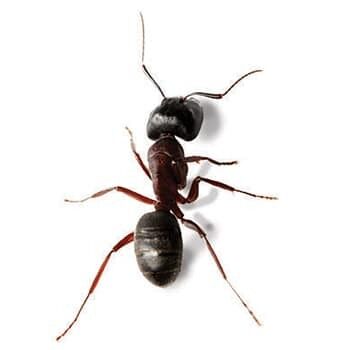
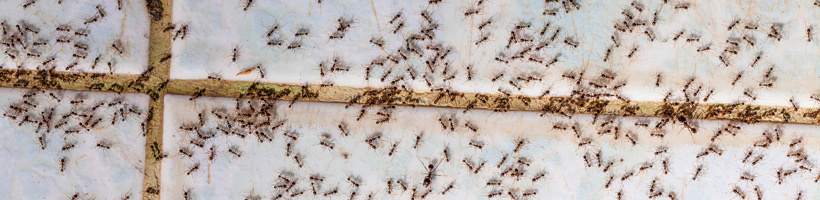
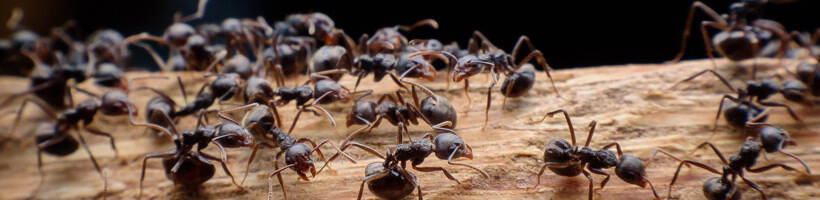
Professionals explain ants are small, six-legged insects with small bodies broken into three parts a head, thorax, and abdomen. Most ants in the Atlanta, Augusta, Fayetteville, Woodstock, Suwanee, Marietta, Hiram, and Aiken SC areas are black, red, and/or orange in color. Pest control experts at Peachtree Pest Control explain most likely, you won’t see ants alone as they are social creatures that live together and work together to accomplish tasks like finding food and building their colonies. If you see a long line of insects traveling toward a food source, they’re most likely ants.
“People assume small ants are baby ants, but the juvenile stage of an ant is actually a larva and does not look like adults,” says Craig S. “A small ant is just a small ant.”
Be careful, though, as ants do resemble termites and are often confused. Professionals explain the main differences between the two are that ants have much larger heads, their bodies narrow between the heads and thorax areas, and they have antennae that appear to bend in the middle like elbows.
How Do I Get Ants?
Ants tend to move around frequently in search of food and water sources. While some of these food and water sources are within our control, others are not. As ants like to eat naturally occurring items like nectar, fungus, seeds, and some mammals, even the cleanest home or business in Atlanta, Augusta, Fayetteville, Woodstock, Suwanee, Marietta, Hiram, and Aiken SC may be susceptible to an ant intrusion. Additionally, the frequent movement from location to location can create frustration when trying to get rid of ants with DIY methods. The ant pest control experts at Peachtree Pest have extensive knowledge of the habits of each type of ant found in Atlanta, Augusta, Fayetteville, Woodstock, Suwanee, Marietta, Hiram, and Aiken SC is integral for ant extermination and ant control.
The experts at Peachtree Pest Control explain ants are cold-blooded insects, their movement habits are greatly affected by the temperature. During the warmer months of the year in Atlanta, Augusta, Fayetteville, Woodstock, Suwanee, Marietta, Hiram, and Aiken SC, ants move around frequently in search of food, water, and new shelter space. However, when the temperatures drop, ants look for areas to keep their internal temperature up.
Unfortunately, an unsecured home or building can seem quite inviting for an ant colony during the colder winter months. Just because ants are more active in the warmer months, it doesn’t mean you don’t run the risk of dealing with ants during the colder times of the year.

What Are the Effects of Ants In and Around My Home or Business?
Depending on the type of ants you’re dealing with at your home or business in Atlanta, Augusta, Fayetteville, Woodstock, Suwanee, Marietta, Hiram, and Aiken SC, the negative effects vary. Because ants are so small and will travel through almost any environment, they can track garbage and filth and, consequentially unhealthy bacteria. While most smaller ants do not bite, larger ants, like carpenter ants, can. In the 1980s, 75% of urban shade trees sampled in Atlanta were infested with carpenter ants. Fast forward several decades and the pests are still a problem in Atlanta, Augusta, Fayetteville, Woodstock, Suwanee, Marietta, Hiram, and Aiken SC.
How Long Do Ants Live?
Throughout Atlanta, Augusta, Fayetteville, Woodstock, Suwanee, Marietta, Hiram, and Aiken SC, ants can live anywhere from a few weeks up to several years. Life span is dependent on the species of the ants, the conditions they live in, their exposure to natural predators, and what role the ants play within the colony. For example, the pest control experts at Peachtree Pest state queen ants can live up to an astonishing 30 years, while worker ants may only live a few weeks.
How Do I Prevent Ants in my Home or Business?
Ant prevention requires a multifaceted approach to have the best results. Professionals advise not leaving excess food, trash, spilled liquids, pooled water, or crumbs around your home or business property. While these are not necessary to attract an ant infestation, there’s no need to make your property more appealing.
Beyond this, professional ant pest control is the ideal approach. It’s important to properly identify the type of ants you’re dealing with and understand the right approach to get rid of that particular species. The approach to dealing with red pavement ants outside is different than the approach to exterminate carpenter ants living inside your home or business in Atlanta, Augusta, Fayetteville, Woodstock, Suwanee, Marietta, Hiram, and Aiken SC. The ant pest control experts at Peachtree Pest are integral in proper identification and will help you formulate an effective and minimally invasive ant control treatment plan.
Flying Ants
Flying ants are matured male and female ants with the sole purpose to leave the ant colony and mate. These flying ants, also known as swarmers, leave when it is time for the ant colony to expand. Flying ants leave their colony as the weather begins to warm and when there is high humidity. You can expect to see groups of flying ants during the spring and early summer throughout Atlanta, Augusta, Fayetteville, Woodstock, Suwanee, Marietta, Hiram, and Aiken SC. Flying ants also tend to swarm in large numbers to keep predators away. Once the male and female flying ant have mated, the male flying ant will die and the female flying ant will find a place to nest and begin its own colony. This female flying ant will now be the queen ant of her colony.
Are Flying Ants Dangerous?
Flying ants carry the same characteristics as their crawling counterparts. A common sugar ant does not bite or sting, so a flying sugar ant will not bite or sting. Some species of flying ants, such as flying carpenter ants, do have the ability to bite if they feel threatened. As long as you do not disrupt a swarm of flying ants while they are mating, you do not have to worry about being bitten.
Flying Ants vs. Termites. What Are the Differences?
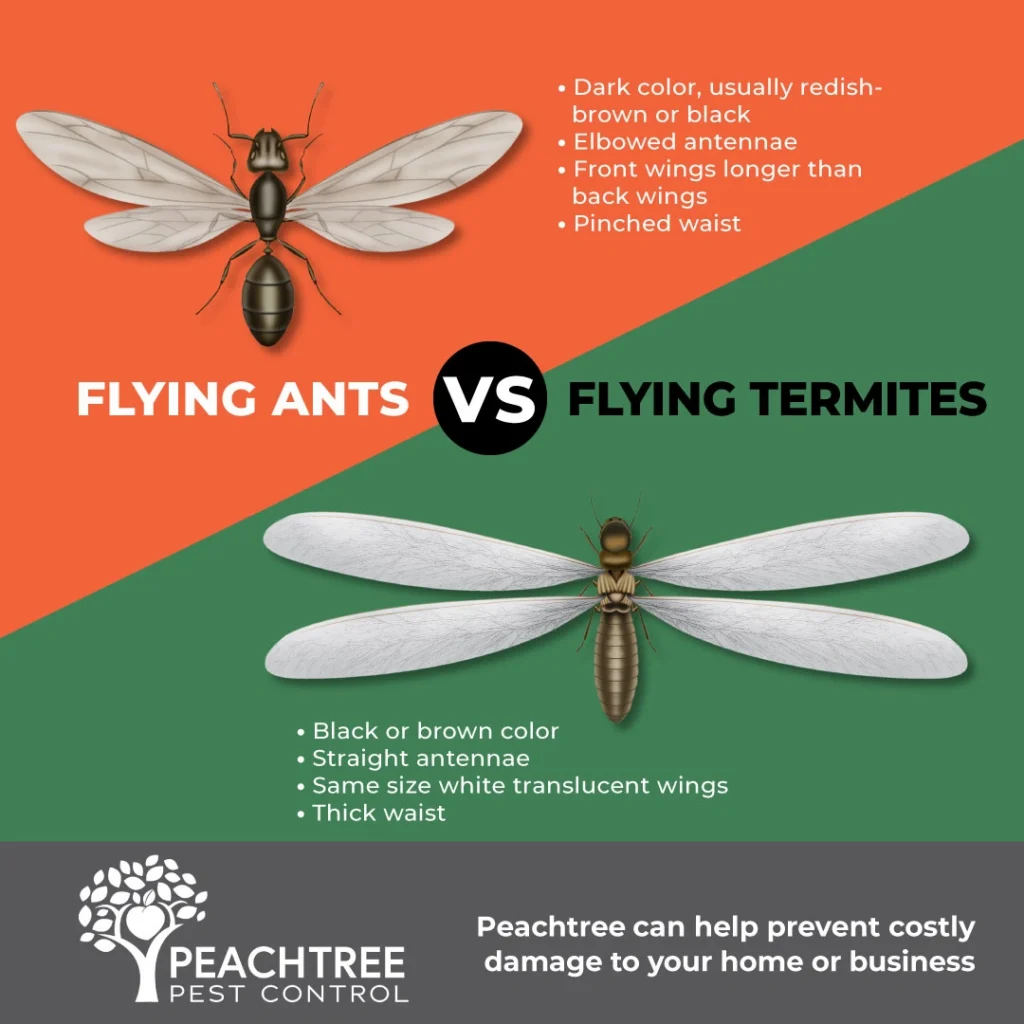
Flying ants are sometimes mistaken for termites due to their swarming nature. The best ways to determine a flying ant from a swarming termite are their wings, antenna, and body shape. A swarming termite will have a straight antenna, equal wing lengths, and a narrow body that is all one width. A flying ant will have a bent antenna, larger front wings, smaller back wings, and a pinched waist. The best way to determine the type of flying insect you are seeing is to call the pest control professionals at Peachtree Pest Control. Our certified pest management experts will examine the flying insect and provide their findings as well as a proactive pest management plan to eliminate the pest and prevent costly damage to your home or business.
Protecting Your Home or Business From Ants With Peachtree Pest Control
Peachtree Pest Control offers expert treatment designed to effectively and efficiently control and prevent pests from invading your home or business in Atlanta, Augusta, Fayetteville, Woodstock, Suwanee, Marietta, Hiram, and Aiken SC. Our use of Integrated Pest Management (IPM)(opens in new tab) techniques focuses on finding the core of the pest concern and controlling Ants from the source. Through IPM, pest control materials are selected and applied in a manner that minimizes risks to human health, pets, and the environment.
Call Peachtree Pest Control today for your FREE and NO OBLIGATION estimate at 855-732-2487 or Schedule Online today!
GET A FAST & FREE ESTIMATE






Pest Control for Ants FAQs
A few ants near a sink or pantry do not always mean there is a large colony indoors, but repeated sightings are a warning sign.
Look for steady trails along baseboards, window sills, counters, plumbing lines, exterior walls, or foundation edges. Ants often follow scent trails, so the same route may appear again even after you wipe up the insects you can see.
You may also notice small piles of soil, sawdust-like debris from carpenter ants, ants entering through gaps, or winged ants gathering near windows and lights.
Food crumbs, pet food, moisture, and trash can make the problem easier to spot, but clean homes can still have ants because colonies forage widely.
If ants keep returning after cleaning and store-bought products, the nest may be hidden in a wall void, crawl space, landscape bed, or outdoors. At that point, professional ant control can help determine the species, nesting location, and appropriate treatment approach.
Several ant species are common around Suwanee, GA and surrounding communities, and correct identification matters because each species behaves differently.
Odorous house ants are small and dark and can produce a strong, rotten-coconut-like odor when crushed. Pavement ants are also small and often nest near sidewalks, driveways, and foundation cracks.
Carpenter ants are larger, usually black or dark reddish, and may be associated with moisture-damaged wood, although they do not eat wood the way termites do.
Acrobat ants can raise their heart-shaped abdomen when disturbed and may nest in damp or decayed wood. Citronella ants are often yellowish and may release a lemon-like odor when crushed.
Flying ants can appear during mating swarms and are sometimes confused with termites. A pinched waist, bent antennae, and front wings that are longer than the rear wings point toward ants rather than termites.
If you are unsure, saving a sample or taking a clear photo can help us confirm what you are seeing before choosing a control method.
Professional ant control usually combines inspection, species identification, targeted treatments, and prevention rather than relying on one product.
Baits are often useful because foraging ants carry the material back toward the colony, but bait choice can depend on whether the ants are feeding on sugars, proteins, oils, or a changing mix of foods.
Exterior perimeter applications may help reduce ants entering from landscape beds, cracks, and foundation edges. In some cases, direct nest treatment is appropriate when the colony location can be identified.
For carpenter ants, moisture sources, damaged wood, and hidden nesting areas deserve close attention because treating visible trails alone may miss the main problem.
Peachtree Pest Control uses integrated pest management principles, which means we look for the source of the problem, entry points, and conditions that support ant activity.
Products are selected and applied with attention to people, pets, property, and the environment. The appropriate method depends on the ant species and where the colony is located.
Ant-control services are designed with safety in mind, but any pest-control product should be handled and applied according to its label.
We use professional products according to label directions and choose lower-impact and environmentally conscious approaches whenever appropriate.
Placement also matters. Baits may be positioned where ants can find them while limiting unnecessary contact, and liquid applications can be directed to cracks, crevices, exterior zones, or other targeted areas.
Before service, we may ask that children and pets stay away from treatment areas during application and until the technician says those areas are ready to use again.
The exact guidance depends on the product, application area, and property layout.
It is also important not to move bait placements, spray over them, or allow pets to disturb them because that can reduce their effectiveness.
If anyone in the home has specific health concerns, speak with a qualified health professional and let us know before service so we can discuss product choices and precautions.
How quickly ant activity improves depends on the species, colony size, nest location, weather, sanitation conditions, and treatment method.
Some visible trails may decline relatively soon after service, especially when ants are entering through a clear exterior route.
Bait-based control can take longer because the goal is for foraging ants to carry the material back toward the colony rather than simply kill the ants visible on the counter.
You may still see ants for a period after service as they continue moving along established trails or respond to bait placements.
Large outdoor colonies, multiple nests, carpenter ants in structural voids, or significant moisture problems may take longer and can require additional steps.
Cleaning food residue, correcting leaks, and avoiding repellent sprays around bait placements can help the treatment work as intended.
If trails increase, move to new areas, or continue without improvement, let us know so we can reassess the situation.
The need for follow-up service depends on the ant species, nesting location, severity of the problem, and whether conditions around the property continue to support colonies.
A small ant issue tied to a single entry point may not require the same approach as carpenter ants nesting in damp wood or repeated outdoor colonies moving toward the structure.
Seasonal conditions also matter. Warm, humid periods can increase foraging, while colder weather may push ants indoors in search of shelter.
Recurring protection can be useful when ants are part of a broader pest pattern around the property, especially where landscaping, moisture, mulch, tree limbs, or foundation gaps create favorable conditions.
Peachtree’s home pest protection plans provide recurring service options for household ants and other common pests.
We avoid recommending one schedule for every property. During an ant-control visit, we can explain whether a one-time response, follow-up service, or ongoing preventive pest management makes the most sense.
DIY steps can help when the problem is limited to a few foraging ants and an obvious food source.
Cleaning spills, sealing food, taking out trash, trimming vegetation away from the building, and reducing moisture are worthwhile first steps.
Professional service makes more sense when ants keep returning, trails appear in several rooms, winged ants are showing up indoors, you suspect carpenter ants, or you cannot locate the source of the activity.
Some repellent sprays can interfere with baiting or cause ant activity to shift, depending on the species and product. They may also kill visible workers without addressing the main colony.
Peachtree Pest Control brings more than 50 years of experience to ant identification and pest management for homes and businesses.
If the problem is recurring, spreading, or difficult to identify, professional service can provide a more targeted approach than repeating short-term DIY treatments.
A professional ant-control service begins with understanding where ants have been seen, how long the problem has been occurring, and what conditions may be attracting them.
We check trails, entry points, moisture sources, nearby landscaping, food-storage areas, wall-void indicators, exterior nesting sites, and other signs that may help identify the species.
Identification guides treatment because odorous house ants, pavement ants, carpenter ants, and other species do not always respond to the same methods.
Treatment may include bait placements, exterior applications, crack-and-crevice work, direct nest treatment when accessible, and recommendations to reduce food, water, and shelter sources.
We also explain what to avoid after service, such as spraying over or disturbing bait placements.
If follow-up service is appropriate, that recommendation will be based on what we find and how the ants respond.
Peachtree Pest Control focuses on practical control and prevention rather than treating every property the same way.
Good preparation helps the service focus on the colony rather than competing food and water sources.
Before we arrive, clean up crumbs, sticky spills, grease residue, and food debris on counters, floors, and inside cabinets where ants have been seen.
Store open food in sealed containers, remove trash, rinse recyclables, and avoid leaving pet food out for long periods.
If ants are active near a sink, dishwasher, bathroom, or laundry area, note any leaks or damp spots so we can evaluate moisture as part of the problem.
Avoid applying repellent sprays to active trails before service when possible because they can interfere with baiting or alter where ants are traveling.
Keep pets away from areas where ants are most active until the technician provides service-specific guidance.
If possible, take photos of trails or save a sample in a small container. That information can speed up identification and help us choose the most appropriate control method.
Looking For Pest Control Services in Your Area?
Peachtree Pest Control provides expert pest control, extermination, and wildlife removal services throughout Georgia, North Carolina and South Carolina: